Pearson Edexcel · GCSE · Business
Course version: 1BS0 · Version from Sept 2017
Sources of finance for growing and established businesses: ● internal…
Full specification wording
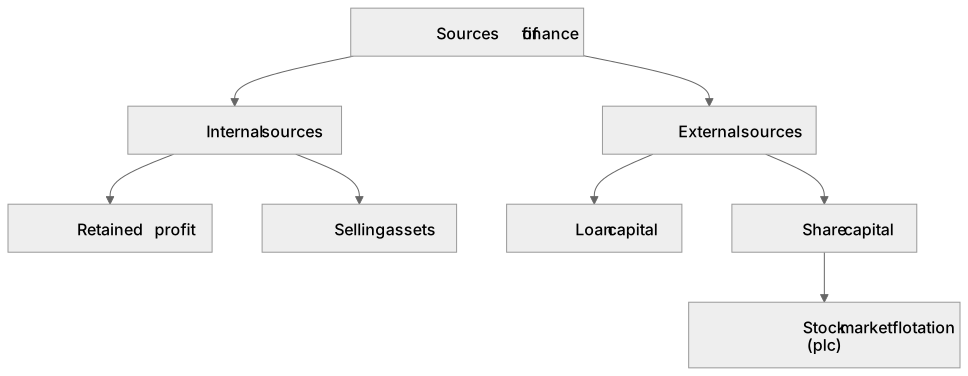
Business growth: Sources of finance for growing and established businesses: ● internal sources: retained profit, selling assets ● external sources: loan capital, share capital, including stock market flotation (public limited companies).
Growing and established businesses require finance to fund expansion.
Checked against the Pearson Edexcel 1BS0 specification (opens in a new tab) on .
- Point 3 of 3
- 4 key terms
Study notes
From the checked teaching notes for this specification point.
The idea
Growing and established businesses require finance to fund expansion. Internal sources are generated from within. Retained profit is the cheapest source, incurring no interest, but may be insufficient for major growth. Selling assets, like outdated machinery, raises funds but removes those resources from the business. External sources come from outside. Loan capital, such as a bank loan, provides immediate funds but must be repaid with interest, increasing fixed costs. Share capital involves selling ownership stakes. For massive expansion, a business might undergo a stock market flotation, converting to a public limited company (plc) to sell shares to the public. This raises substantial capital without interest, though it dilutes ownership.
What earns the marks
- Retained profit is an internal source of finance that does not require interest payments or dilute ownership.
- Selling assets generates internal finance by disposing of items the business no longer needs, such as old vehicles.
- Loan capital is an external source that must be repaid with interest, which increases the financial risk and fixed costs of the business.
- Share capital provides external finance without the need for repayment, but it requires giving up a percentage of business ownership.
- Stock market flotation allows a business to become a plc and raise significant external finance by selling shares to the general public.
Common mistakes and how to put them right
Stating that share capital must be repaid with interest.
Put it right: Share capital does not need to be repaid and does not incur interest; instead, shareholders may receive dividends from profits.
Confusing internal and external sources of finance.
Put it right: Retained profit and selling assets are internal because they come from within the business, whereas loans and share capital are external.
Assuming a private limited company can use stock market flotation.
Put it right: Only public limited companies (plcs) can float on the stock market to sell shares to the general public.
Exam tips
- When recommending a source of finance, always consider the financial position of the business, such as its existing debt levels or profitability.
- Contrast the cost of loan capital (interest payments) with the cost of share capital (loss of control and dividend payments) in evaluation questions.
- Link the scale of the finance needed to the source; stock market flotation is suitable for massive expansion, whereas retained profit suits smaller, organic growth.
Try the lesson
The start of the Business growth: Sources of finance for growing and established businesses: ● internal sources: retained profit, selling assets ● external sources: loan capital, share capital, including stock market flotation (public limited companies). lesson, made from checked teaching notes for this specification point.
Have a go first
Which of the following is an example of an internal source of finance for an established business?
Listen
Growing and established businesses require finance to fund expansion. Internal sources are generated from within. Retained profit is the cheapest source, incurring no interest, but may be insufficient for major growth. Selling assets, like outdated machinery, raises funds but removes those resources from the business. External sources come from outside. Loan capital, such as a bank loan, provides immediate funds but must be repaid with interest, increasing fixed costs. Share capital involves selling ownership stakes. For massive expansion, a business might undergo a stock market flotation, converting to a public limited company (plc) to sell shares to the public. This raises substantial capital without interest, though it dilutes ownership. A strong answer earns marks for these points. Retained profit is an internal source of finance that does not require interest payments or dilute ownership. Selling assets generates internal finance by disposing of items the business no longer needs, such as old vehicles. Loan capital is an external source that must be repaid with interest, which increases the financial risk and fixed costs of the business. Share capital provides external finance without the need for repayment, but it requires giving up a percentage of business ownership. A common slip: Stating that share capital must be repaid with interest. Instead, Share capital does not need to be repaid and does not incur interest; instead, shareholders may receive dividends from profits. Exam tip: When recommending a source of finance, always consider the financial position of the business, such as its existing debt levels or profitability.
See it
Key words
Say what each word means before you turn the card.
Retained profit
Try answering aloud or in your head before turning the card.
Selling assets
Try answering aloud or in your head before turning the card.
Loan capital
Try answering aloud or in your head before turning the card.
Share capital
Try answering aloud or in your head before turning the card.
See every definition
- Retained profit
- An internal source of finance that is the cheapest source, incurring no interest, but may be insufficient for major growth.
- Selling assets
- An internal source that raises funds by disposing of items the business no longer needs, such as outdated machinery, but removes those resources from the business.
- Loan capital
- An external source, such as a bank loan, that provides immediate funds but must be repaid with interest, increasing fixed costs.
- Share capital
- An external source that involves selling ownership stakes and provides finance without the need for repayment, but requires giving up a percentage of business ownership.
Label the diagram
Some boxes have lost their names. Pick the right name for each number.
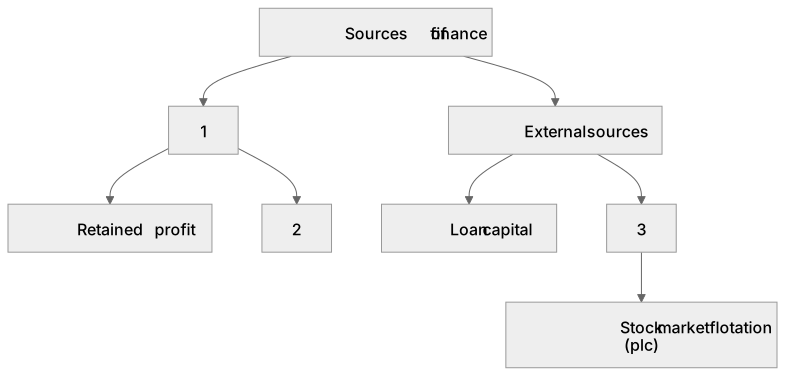
1Box 1
2Box 2
3Box 3
There is more to this lesson
The full lesson goes on to check your understanding and help you earn the marks. Create a free account to carry on, with your progress saved.
A week of Premium from your first lesson · Then the free plan continues · No card, no charge
Test your understanding of Business growth: Sources of finance for growing and established businesses: ● internal sources: retained profit, selling assets ● external sources: loan capital, share capital, including stock market flotation (public limited companies).
Active recall beats re-reading. Take an instant quiz now to test what you’ve learned and lock it into long-term memory.
A week of Premium from your first lesson · Then the free plan continues · No card, no charge